

Relationships and Architecture
Relationships make the architecture work.
Hard problems bring many forms of knowledge, experience, capability, authority, and consequence into the same changing landscape. Each contribution may be useful. Their relationships determine whether they become coherent enough to support purposeful action.
PHRONEXUSworks™ provides a learning and operational architecture for organizing those relationships. It connects understanding with capability, decisions with resources, action with consequences, and evidence with what happens next.
The architecture can be entered wherever the situation calls.
A team may need to understand what is happening. A leader may need to clarify a decision. An organization may need capability that does not yet exist. A community may need its experience and consequences brought into the picture. Evidence may show that an existing problem frame no longer fits.
Each need offers an entry point. The architecture helps people begin where attention is required while keeping the wider relationships available.

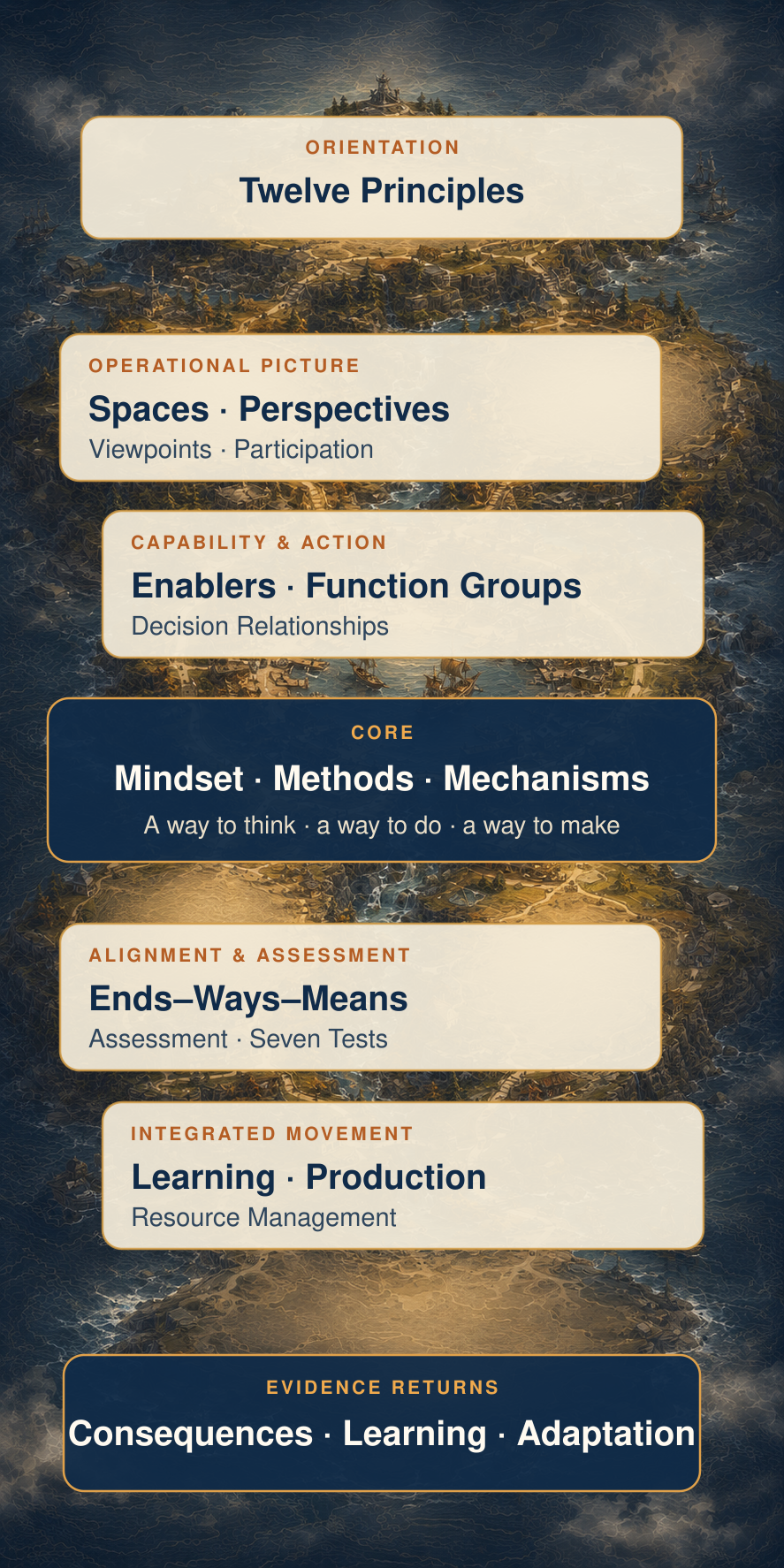
Terraced landscape showing the connected layers of the PHRONEXUSworks operational architecture: orientation, operational picture, capability and action, Mindset–Methods–Mechanisms at the core, alignment and assessment, integrated movement, and evidence returning through consequences, learning, and adaptation.
It is a learning architecture.
Inquiry, action, consequences, and evidence continually revise what is understood. Learning runs through the complete architecture and changes what people and organizations may be able to do next.
It is an operational architecture.
Functions, roles, capabilities, constraints, interfaces, resources, and decisions must work together under real conditions. The architecture organizes those relationships so understanding can influence action.
Learning keeps the picture current. Operational relationships make the picture usable. Together, they provide continuity while the situation changes.
A way to think, a way to do, and a way to make remain connected.
PHRONEXUSworks™ organizes the architecture through Mindset, Methods, and Mechanisms. They describe different contributions to the work, but they remain in continual interaction.
Mindset orients understanding and judgment.
A way to think supports curiosity, discernment, systems awareness, practical wisdom, learning, and openness to revision. It influences what enters the picture, what receives attention, and how participants interpret what they encounter.
Methods organize inquiry and action.
A way to do provides disciplined approaches for exploring situations, framing problems, developing decisions, integrating contributions, building capability, coordinating action, and assessing what occurs.
Mechanisms make capability operational.
A way to make connects people, processes, tools, resources, authority, information, and timing. Mechanisms allow understanding and intention to become coordinated practice and meaningful effects.
Mindset without method may remain insight. Method without mechanisms may remain intention. Mechanisms without a disciplined mindset may produce activity disconnected from purpose. Their interaction carries practical reasoning into the world.
Principles orient movement through the architecture.
The twelve principles articulate what PHRONEXUSworks™ has learned through its development and use. They are organized around four recurring orientations. Practitioners move among them as the situation, purpose, and evidence require.
Understand What Is
- 01Examine context before framing.
- 02Seek perspectives that broaden understanding.
- 03Trace relationships and interactions.
Understanding begins with the situation and remains open to what additional inquiry may reveal.
Organize What Matters
- 04Integrate contributions into coherence.
- 05Structure complexity while preserving what matters.
- 06Let purpose discipline inquiry.
Organization makes relationships intelligible enough to support judgment and action.
Act While Learning
- 07Apply practical wisdom.
- 08Use action as a source of inquiry.
- 09Build capability for purposeful action.
Action creates experience. Experience becomes useful when it changes understanding and capability.
Evolve Deliberately
- 10Assess consequences continuously.
- 11Enable adaptation as conditions change.
- 12Anticipate co-evolution and emerging trajectories.
Present commitments influence the conditions and possibilities that will be encountered later.
The principles are neither phases nor a checklist to complete once. Learning connects all four orientations and keeps them active throughout the work.
What people can understand depends on what enters the picture and where they stand.
Start Here introduced Situation, Problem, and Decision Spaces. Within the larger architecture, the spaces provide working regions for inquiry. Perspectives and viewpoints influence how participants interpret what those regions contain.
The spaces organize attention.
Situation Space develops an understanding of what is happening. Problem Space frames what matters and where action may be needed. Decision Space forms choices, alternatives, commitments, and possible consequences.
Movement among the spaces continues. A possible action may expose a missing relationship. New evidence may change the problem frame. Consequences return to an updated situation.
Problem character emerges through dimensions, factors, and aspects.
These three distinctions help participants develop the Problem Space without reducing the situation too quickly. They examine different features of the same changing landscape.
Problem Dimensions
Dimensions suggest where to look and where the problem may live. They broaden inquiry beyond familiar professional boundaries and help expose consequential areas that might otherwise remain outside the picture.
Problem Factors
Factors reveal what is shaping the particular situation. Constraints, dependencies, capabilities, policies, technologies, resources, relationships, expectations, and events may influence several dimensions at once.
Problem Aspects
Aspects help explain how the problem behaves as those influences interact: complexity, uncertainty, dynamism, bounded rationality, bounded irrationality, and time sensitivity.
Dimensions broaden the field. Factors populate it. Aspects reveal its behavior. Their salience may change as the situation develops.
Explore the eleven Problem Dimensions
- Purpose and value
- Individual sense making
- Collective meaning
- Power and governance
- Value and trade-offs
- Social legitimacy
- Information coherence
- Organizing and managing
- Technical realization
- Disciplinary systems
- Environmental fit
Perspective filters knowledge.
Every participant draws from blended Practitioner, Academic, and Stakeholder and User knowledge. The blend reflects experience, learning, practical skill, purpose, and perceived relevance.
Viewpoint locates the participant.
A viewpoint reflects where someone stands in the situation: role, responsibility, authority, interest, timing, exposure, and relationship to consequences. Participants may occupy similar viewpoints while interpreting them through different perspective blends.
Participation connects knowledge, authority, and consequence.
Who participates, when they enter the work, what they can contribute, which decisions they can influence, and which consequences they may experience all shape the Operational Picture.
Participation should change as understanding, decision needs, capabilities, and conditions develop. The people most affected by an action may not hold formal authority, but their knowledge and lived consequences remain consequential to responsible judgment.
Integrated discernment connects the picture.
Discernment helps participants recognize where attention is needed, which differences remain consequential, what may be sufficiently understood, and when inquiry should move elsewhere. Coherence can develop without requiring every participant to see the situation identically.
The spaces organize inquiry. Perspectives shape interpretation. Viewpoints expose location and consequence. Discernment helps those contributions become usable together.
Participation requires capabilities at more than one level.
The architecture depends on conditions that enable people to understand, work together, and sustain relationships across a larger system. PHRONEXUSworks™ groups these capabilities into three interacting sets.
Individual-Cognitive enablers support personal discernment.
Curiosity, openness, reflection, learning, judgment, awareness of bias, and willingness to revise help individuals examine what they notice and how they interpret it.
Group-Collaborative enablers develop shared capability.
Communication, translation, trust, participation, constructive disagreement, shared representations, and coordinated judgment help groups bring different contributions into relationship.
Systems-Integrative enablers sustain connected action.
Governance, interfaces, decision rights, feedback, institutional memory, resource alignment, and adaptive structures help work remain coherent across organizations, institutions, technologies, and communities.
Enablers do not remove difference or uncertainty. They make it possible to work with them deliberately across individual, group, and system relationships.
Four function groups organize the work performed.
The function groups describe recurring kinds of work across the architecture. They interact continuously rather than forming a fixed sequence.
Sensemaking develops understanding.
Participants observe, interpret, compare, and relate what they encounter. Sensemaking brings conditions, signals, meanings, experiences, and uncertainties into a developing Operational Picture.
Structuring makes relationships examinable.
Boundaries, models, representations, problem definitions, requirements, roles, and interfaces organize what has been learned so it can be shared, questioned, and applied.
Disciplining connects inquiry with purpose.
Evidence, assumptions, trade-offs, ethics, criteria, authority, Ends–Ways–Means, and practical judgment help keep understanding and action coherent with what matters.
Outcomes reveal effects and consequences.
Action produces intended and unintended changes in conditions, relationships, capabilities, burdens, opportunities, and expectations. Those effects become evidence for assessment and continued learning.
Sensemaking develops the picture. Structuring makes it usable. Disciplining keeps it connected to purpose. Outcomes show what the work produced and what the situation may require next.
A decision must be formed before alternatives can be judged well.
These closely related activities contribute different things to the Decision Space.
Decision-making support forms the decision need.
Participants examine what requires judgment, why it matters, whose perspectives and consequences belong in the picture, what constraints shape the space, and which commitments may be possible. This work disciplines what is actually being decided.
Decision support develops choices and alternatives.
Evidence, analysis, models, criteria, comparisons, scenarios, professional knowledge, and practical experience help develop and examine possible responses once the decision need is sufficiently understood.
Choice-making commits direction and responsibility.
People exercise judgment, accept accountability, and commit authority, capability, and resources to a course of action.
Analysis becomes more useful when it supports a decision that has been carefully formed. Commitment becomes more responsible when alternatives have been examined in relation to purpose, capability, and potential consequences.
Learning, capability, and resources move together.
The three cycles operate simultaneously across the architecture. Each contributes a different relationship while continually affecting the others.
The Learning Cycle keeps understanding current.
Sequence
Understand → Focus → Act → Do → Check → Learn
Inquiry and action develop evidence. Evidence can confirm, refine, or overturn what participants thought they understood.
The Production Cycle develops usable capability.
Sequence
Knowledge → Concept → Capability → Process → Outcomes → Assessment
Knowledge becomes consequential when it changes what people and organizations can reliably do under real conditions.
The Resource Management Cycle aligns commitment.
Sequence
Ends → Ways → Means
Purpose, approach, and resources must remain connected as circumstances change. Resources support the mission; they should not quietly redefine it.
New understanding may require redesigned capability. New capability may require different resources or governance. Resource constraints may alter the Decision Space. The cycles remain integrated because change in one can reshape the others.
Purpose disciplines how capability and resources are committed.
Ends–Ways–Means provides a recurring alignment relationship within the Resource Management Cycle.
Ends clarify the purpose and effects sought.
Ends express what matters, for whom, under which conditions, and with what responsibilities toward affected people and future consequences.
Ways shape the approach.
Ways organize how people, organizations, capabilities, processes, partnerships, and authority may work together to pursue the Ends.
Means make action possible.
Means include people, knowledge, time, funding, information, tools, infrastructure, authority, relationships, and other resources needed to act.
Ends, Ways, and Means remain open to reassessment. Changing conditions may require a different approach, new resources, or renewed examination of whether the original purpose remains justified.
Assessment connects consequences with what happens next.
Assessment operates throughout the architecture. It examines developing understanding, capability readiness, process performance, resource alignment, outcomes, consequences, and the continuing fit between the problem frame and the situation.
The seven tests ask complementary questions. No single test defines success by itself.
- Utility
- Does it create value that matters in use?
- Efficiency
- Are resources used responsibly in relation to the value produced?
- Effectiveness
- Does it produce the intended capability, performance, or effects?
- Fairness
- How are benefits, burdens, access, and risk distributed?
- Legitimacy
- Is the work justified, trustworthy, and acceptable to those with a consequential stake?
- Adaptability
- Can understanding, capability, and action change as conditions evolve?
- Sustainability
- Can the relevant relationships, resources, and effects endure responsibly over time?
Assessment connects the three cycles.
Within the Learning Cycle, assessment can revise understanding. Within the Production Cycle, it can reshape capability and process. Within the Resource Management Cycle, it can redirect Ends, Ways, Means, and commitments.
Reframing responds when improvement is insufficient.
Evidence may show that the existing problem definition, boundaries, assumptions, or purposes no longer fit. Reframing returns attention to Situation and Problem Spaces so the architecture can develop a more useful basis for action.
Assessment is a bridge rather than an endpoint. It allows evidence to influence judgment, learning, capability, resources, adaptation, and renewed action.
Present action changes what may become possible next.
Hard problems evolve as participants act within them. Relationships change. Capabilities develop or erode. Institutions adjust. New dependencies appear. Choices that seem reasonable today may expand or restrict tomorrow's options.
Evolution Space examines changing trajectories.
Evolution Space extends inquiry across time. It asks how situations, problems, decisions, participants, technologies, institutions, and consequences may change together.
Functional Opportunity Space reveals available possibilities.
Functional Opportunity Space is the changing field of functions, capabilities, relationships, and choices available to people, organizations, institutions, and society.
An intervention may expand this space by developing knowledge, access, coordination, or capability. It may contract the space through dependence, concentrated control, skill erosion, lost alternatives, or commitments that become difficult to reverse.
Anticipation influences present commitment.
Anticipation does not predict one fixed future. It develops a more disciplined understanding of plausible trajectories, emerging relationships, and capabilities that may be needed before necessity becomes crisis.
What people learn changes what they can do. What they do changes the conditions. Changed conditions alter what becomes possible. The architecture keeps that movement available for inquiry and influence.
The architecture becomes visible through its relationships.
Mindset, Methods, and Mechanisms organize the core. The twelve principles orient how participants move. Spaces and blended perspectives develop the Operational Picture. Enablers support participation and integration. Function groups organize the work. Decision relationships connect judgment with commitment. The cycles carry learning, capability, and resources. Ends–Ways–Means maintains alignment. Assessment returns consequences as evidence. Evolution and Functional Opportunity Space keep future possibilities in view.
No element carries the work alone. Their relationships allow specialized knowledge, professional experience, stakeholder reality, methods, tools, and resources to contribute where they are useful while remaining connected to the larger situation.

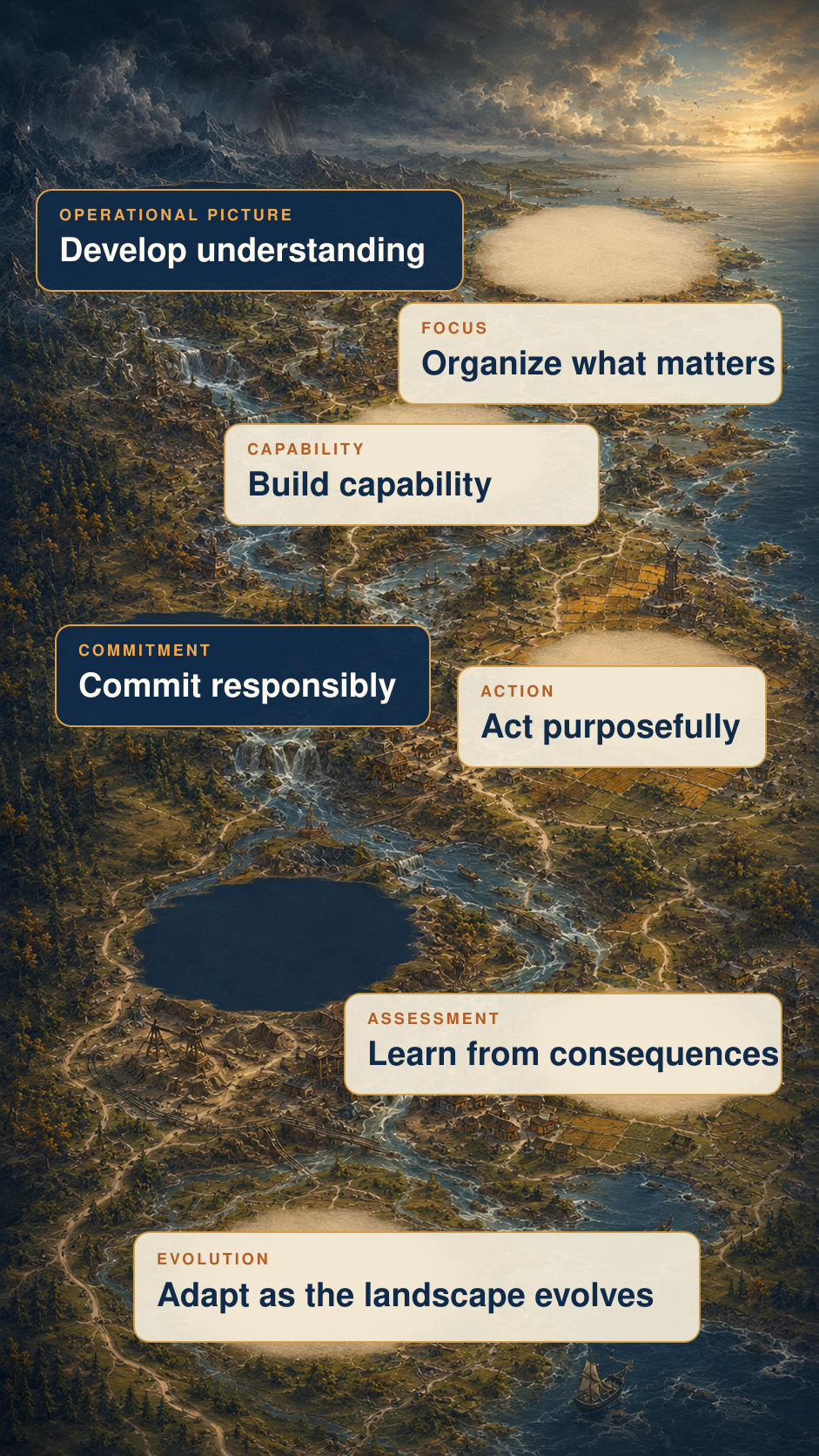
Changing watershed landscape showing the integrated architecture in motion through developing understanding, organizing what matters, building capability, committing responsibly, acting purposefully, learning from consequences, and adapting as the landscape evolves.
Develop understanding. Organize what matters. Build capability. Commit responsibly. Act purposefully. Learn from consequences. Adapt as the landscape evolves.
Continue where your questions lead.
Foundational Works
Explore the three books that establish the operational foundation, provide the visual orientation, and extend the architecture into a co-evolving Human–AI landscape.
Explore the booksResources
Use the Concept Navigator, selected figures, references, papers, and future practical materials to follow particular relationships more deeply.
Explore the resourcesStart Here
Return to the first landmarks and the guided introduction to hard problems, spaces, decisions, perspectives, solution-making, and cycles.
Return to Start HereAbout
Learn about the experience, inquiry, and continuing development behind PHRONEXUSworks™.
Discover the workThe architecture remains open to learning.
PHRONEXUSworks™ organizes relationships without pretending that hard problems stand still. It provides continuity for understanding and action while evidence, experience, capability, and changing conditions continue reshaping what the situation may require.