

Foundational Works
Four books. One evolving architecture.
Hard problems rarely yield to a single method, perspective, or answer. They require people to see more of the situation, recognize where judgment is needed, develop purposeful action, and keep learning as conditions change.
The books of PHRONEXUSworks™ offer different ways into that work. One provides orientation for navigating hard problems. One explores what the Human–AI ecosystem is becoming. One develops the operational foundations that connect figuring out with coordinated action. One examines how a founder can build and guide a capable one-person firm with a Human–AI team.
Begin with the question that matters most to you.
Begin where your questions are.
These books are complementary entry points. Begin with the book that most closely matches the question or situation you face.
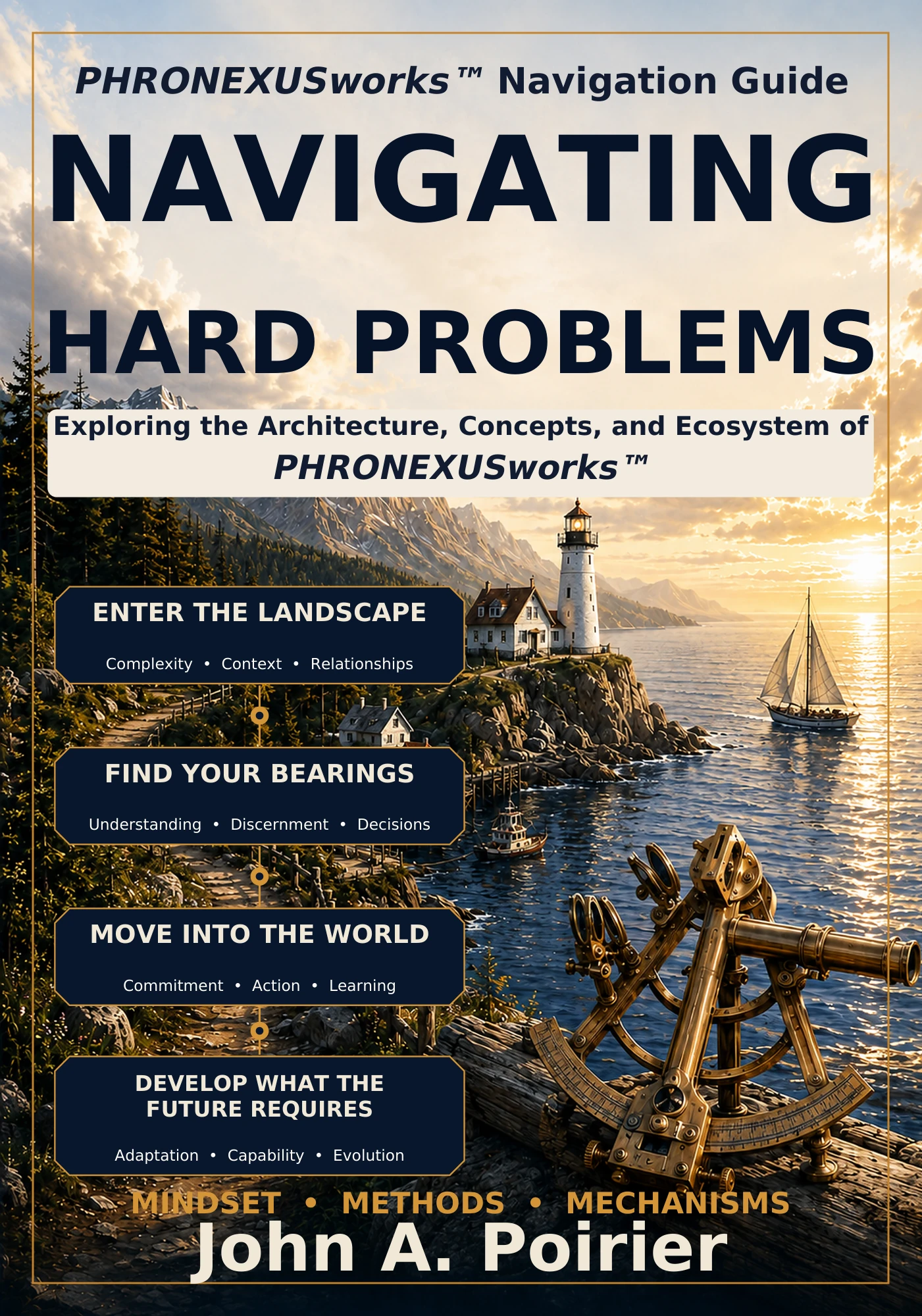
Navigating Hard Problems
Where do I begin?
Published and available now
A visual and conceptual guide to the relationships, spaces, cycles, and principles that help people find their bearings when problems evolve faster than a fixed plan can accommodate.
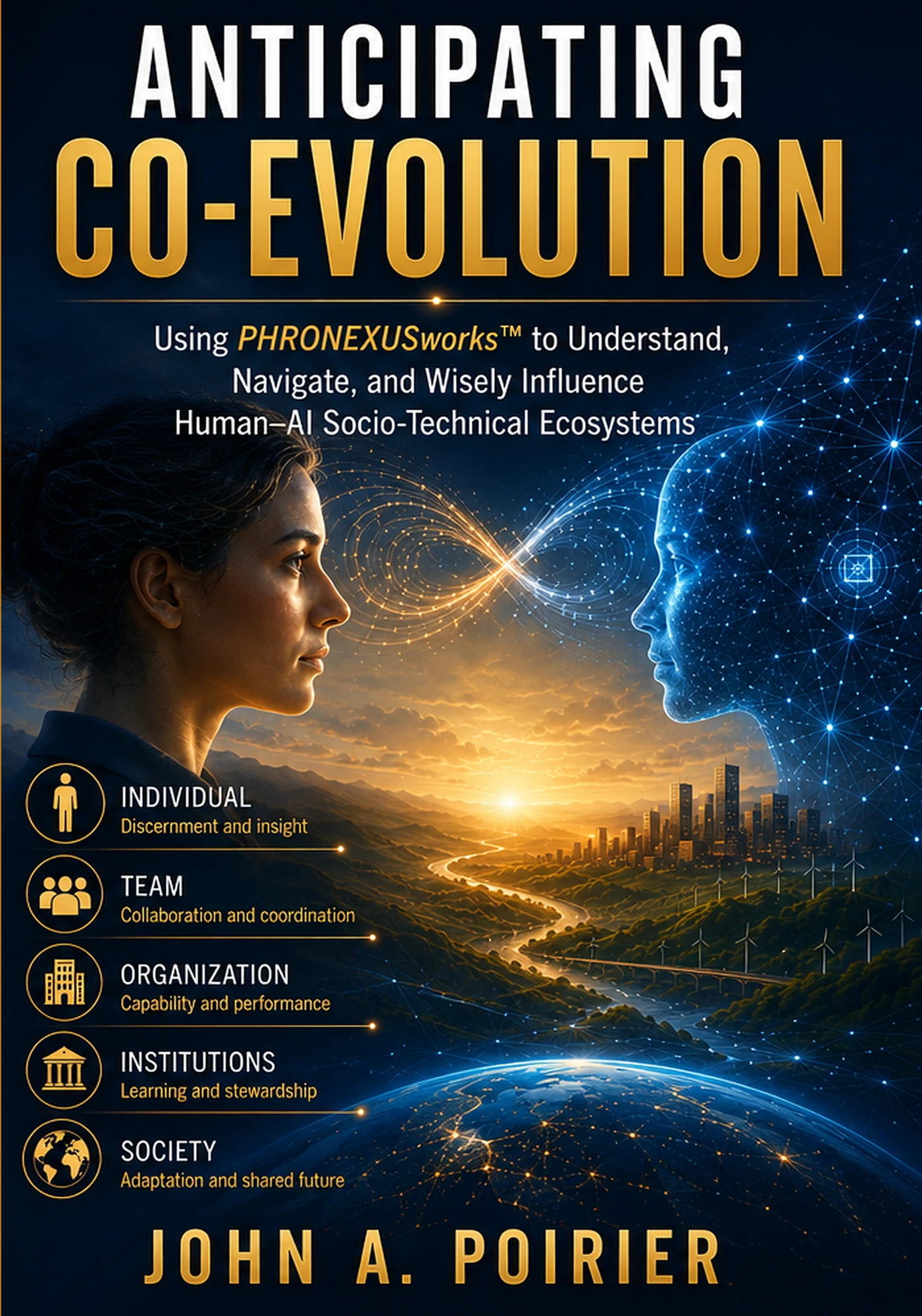
Anticipating Co-Evolution
What is the Human–AI ecosystem becoming?
Published and available now
An exploration of Human–AI co-evolution that also follows how the PHRONEXUSworks™ architecture is applied, tested, and developed as people, teams, organizations, and wider ecosystems learn across scales.
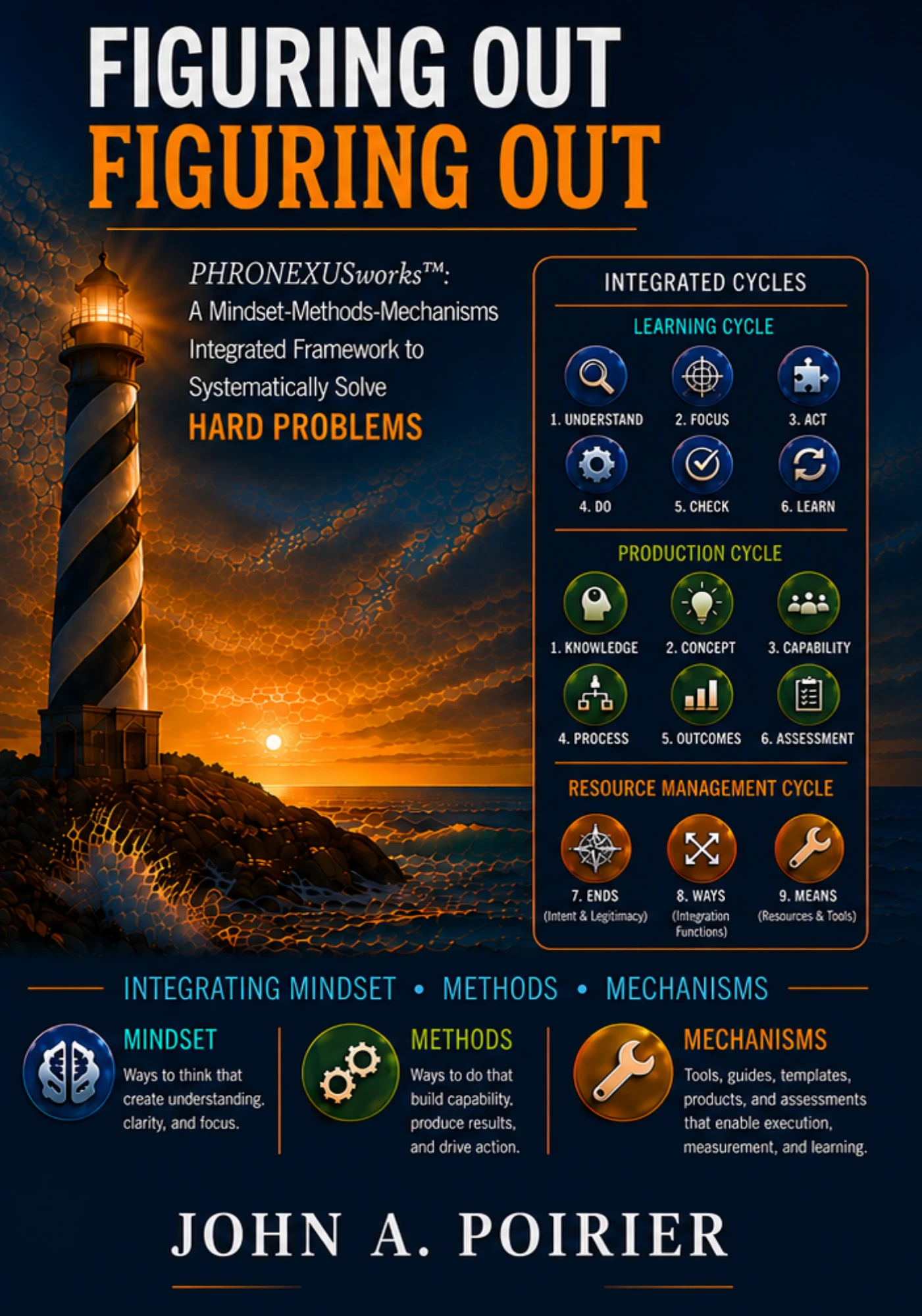
Figuring Out Figuring Out
How does figuring out become coordinated action?
Published and available now
The operational foundation of PHRONEXUSworks™: a deeper treatment of perspective, problem framing, decision needs, capability development, resource alignment, action, assessment, and continued learning, grounded through practical scenarios involving Wi-Fi deployment, hospital operations, wildfire response, and other settings.
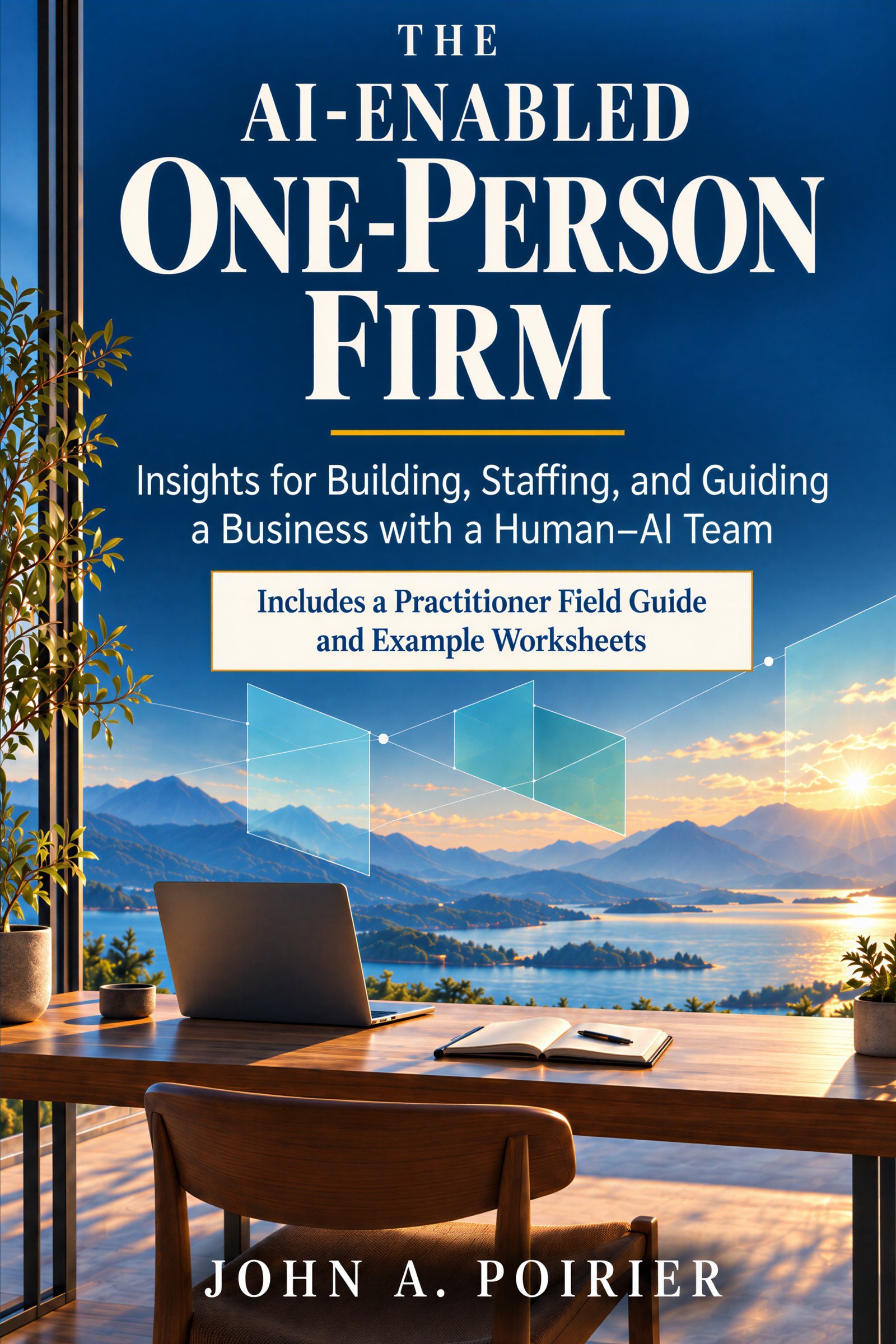
The AI-Enabled One-Person Firm
How can one person build and guide a capable business composed of human and AI contributors?
Available in paperback and Kindle editions.
Insights for building, staffing, and guiding a business with a Human–AI team—including a Practitioner Field Guide and example worksheets that help founders examine purpose, functions, roles, authority, evidence, learning, and attention.
The books connect without becoming a sequence.
Each book opens a different part of the same landscape. Together, they connect orientation, anticipation, and operational development without requiring every reader to follow one prescribed route.
Orientation
Navigating Hard Problems makes the larger landscape easier to see. It introduces the architecture through maps, relationships, landmarks, and principles that support movement through changing conditions.
Evolutionary exploration
Anticipating Co-Evolution turns attention toward the changing Human–AI ecosystem. It examines emerging relationships, possible trajectories, and the capacity to wisely influence development without pretending the future is predetermined. At the same time, it explores how the architecture is applied and how it learns from its own use across individuals, teams, organizations, institutions, and wider ecosystems.
Operational foundation
Figuring Out Figuring Out develops the underlying work in greater depth. It connects understanding, framing, decision needs, capability, resources, coordinated action, assessment, and learning, then carries those relationships into practical scenarios involving Wi-Fi deployment, hospital operations, wildfire response, and other real-world settings.
The books reinforce one another, but each stands on its own. The best starting point is the one that helps you address the question in front of you.
Visual and Conceptual Orientation
Navigating Hard Problems
Finding a path through hard problems requires a guide. This book helps you find your paths.
Published and available now
View on AmazonHard problems develop while people are working within them. Boundaries shift, relationships produce unexpected effects, new knowledge changes what appears consequential, and action alters the conditions that must be understood next.
Navigating Hard Problems provides a visual and conceptual orientation to this changing landscape. It introduces the maps, relationships, spaces, cycles, and principles of PHRONEXUSworks™ in a form designed to help readers recognize where they are, what may require attention, and how continued movement can remain connected to purpose.
The book does not prescribe one route through every problem. It develops landmarks for navigating situations in which understanding, judgment, action, consequences, and learning remain in motion.
Questions this book helps you explore
- What makes a hard problem different from a merely complicated one?
- How do Situation, Problem, and Decision Spaces remain connected?
- Where do perspective, discernment, decision needs, and consequences enter the work?
- How can learning, production, and resource commitments adapt together?
- What principles help people maintain direction without relying on a fixed path?
Especially useful for
Readers seeking an accessible entry into PHRONEXUSworks™; leaders and practitioners facing complex, changing conditions; teams that need a shared orientation before choosing methods or committing resources; and anyone looking for a clearer way to see how the architecture fits together.
Evolutionary Exploration
Anticipating Co-Evolution
Human beings and artificial intelligence are not developing along separate paths. They are changing through continuing interaction—altering how knowledge is produced, how work is organized, how authority is exercised, how choices are formed, and how consequences spread through institutions and society.
Anticipating Co-Evolution explores this developing sociotechnical ecosystem without treating its future as fixed. Using PHRONEXUSworks™, it helps readers examine present conditions, notice emerging patterns, consider multiple trajectories, and understand how choices made now may expand, constrain, or redirect future possibilities.
The exploration also turns the architecture back upon itself. As PHRONEXUSworks™ is applied to Human–AI teams, organizations, institutions, and wider ecosystems, the architecture encounters new relationships, tests its own assumptions, and develops through what its use reveals. This recursive learning connects application with evolution across scales: the architecture supports inquiry into co-evolution while also learning from that inquiry.
The book develops anticipatory capability as a practical discipline. Operational Pictures help make the current situation more visible. Evolution Space supports inquiry into how relationships and conditions may develop. Functional Opportunity Space reveals where capabilities, responsibilities, and forms of action could emerge. Problem Constellations keep connected concerns from being reduced to isolated issues.
Its central concern is not prediction for its own sake. It is the development of shared discernment, institutional learning, and wiser influence within an ecosystem that continues to evolve.
Questions this book helps you explore
- What is changing as human and artificial capabilities develop together?
- Which emerging relationships may become consequential?
- How can groups consider multiple trajectories without claiming certainty?
- Where might new functional opportunities, responsibilities, or risks appear?
- What forms of learning and governance can support wiser influence over time?
- How does applying the architecture across scales reveal ways the architecture itself should develop?
Especially useful for
Leaders, strategists, researchers, educators, policy professionals, technologists, and practitioners who need to think beyond near-term adoption decisions and consider the longer development of Human–AI relationships, institutions, capabilities, and consequences.
Operational Foundation
Figuring Out Figuring Out
Before coordinated action can begin, people must figure out what is happening, what matters, where judgment is required, and what capability the situation demands.
Published and available now
View on Amazon (opens in a new tab)Practical action begins with figuring out what the situation requires. People encounter a situation before they frame a problem. Their perspectives influence what enters the picture. Problem frames shape attention. Decision needs develop before useful choices and alternatives can be created.
Figuring Out Figuring Out provides the operational foundation of PHRONEXUSworks™. It examines how understanding develops across practitioner, academic, and stakeholder or user knowledge; how Situation, Problem, and Decision Spaces interact; and how decision-making support, decision support, and choice-making make distinct contributions.
The book connects that reasoning with capability development and coordinated action. Mindset, Methods, and Mechanisms bring ways of thinking, doing, and making into relationship. Ends, Ways, and Means align purpose, approach, and resources. Integrated cycles carry understanding into capability, outcomes, assessment, learning, and renewed action as conditions change.
Rather than separating analysis from implementation, the book follows the relationships that allow people to move from an encountered situation toward purposeful commitments—and to learn from the consequences that return.
Multiple practical scenarios carry these relationships into application. Wi-Fi deployment, hospital operations, wildfire response, and other settings show how the architecture helps people work through different conditions without suggesting that one procedure or answer fits every situation.
Questions this book helps you explore
- How do situations become problem frames, and how do those frames remain revisable?
- What is the difference between forming decision needs, supporting decisions, and making choices?
- How can different sources of knowledge expand understanding without erasing consequential differences?
- What connects reasoning with people, processes, authority, resources, and timing?
- How can action, assessment, and learning remain connected as the situation changes?
Especially useful for
Practitioners, leaders, educators, analysts, designers, facilitators, and interdisciplinary teams seeking the deeper operational logic of PHRONEXUSworks™—especially when understanding must become coordinated capability and responsible action.
Human–AI Firm Practice
The AI-Enabled One-Person Firm
John A. Poirier
Insights for Building, Staffing, and Guiding a Business with a Human–AI Team
Available in paperback and Kindle editions.
Publication date: September 21, 2026 · Paperback ISBN: 979-8-9967072-3-2
AI is giving individuals access to capabilities that once required larger teams, deeper pockets, and more specialized infrastructure. A one-person firm no longer has to mean one-person capability. AI, software, outside expertise, and the founder’s own judgment can work together to provide many of the functions once associated with a larger organization.
But access to capability does not remove the need for management. It creates a different management problem. The book examines how a founder can determine what functions the firm must perform, decide who or what should execute them, retain appropriate authority, manage quality and evidence, and direct limited attention where it matters most.
A Practitioner Field Guide translates the ideas into working questions and practical records. Twelve completed two-page examples demonstrate how the accompanying PHRONEXUSworks™ Application Worksheets can be used to examine purpose, functions, roles, authority, evidence, learning, and founder attention.
Questions this book helps you explore
- How can one person build and guide a capable business composed of human and AI contributors?
- What functions must the firm perform, and who or what should execute them?
- Where should the founder retain authority as capability expands?
- How can quality, evidence, and learning be managed without a large staff?
- Where should limited founder attention be directed as the firm develops?
Especially useful for
Founders, independent practitioners, and small-firm leaders who are building or guiding AI-enabled operations; professionals designing Human–AI work arrangements; and readers who want practical worksheets for examining purpose, roles, authority, evidence, and attention inside a one-person firm.
The next path is yours to choose.
The books provide different ways to enter the same evolving landscape. Follow the question that matters now, then use the wider PHRONEXUSworks™ architecture and resources to continue exploring the relationships your situation reveals.