
Getting your bearings

The situation comes first.

You encounter a situation before you frame a problem. Conditions, relationships, events, people, purposes, constraints, and possibilities are already interacting. What captures attention begins shaping what you see—and what may remain outside the picture.

PHRONEXUSworks™ helps you get your bearings by connecting what is happening with how problems are framed and how decisions take shape. That connection creates a clearer path from initial understanding toward purposeful action.

Complexity changes the work.

Hard problems evolve while people work within them. Boundaries shift. Relationships produce unexpected effects. New knowledge changes what appears consequential. Actions alter the conditions that future decisions must address.

Complicated problems respond to expertise.

Demanding work may involve many parts, specialized knowledge, careful coordination, and significant resources. Stable boundaries and relationships allow expertise, analysis, planning, and disciplined execution to produce reliable results.

Hard problems require navigation.

Changing conditions keep understanding, action, and consequences in motion. Progress depends on maintaining awareness, learning through engagement, and adapting as the situation develops.

Expertise remains essential. Navigation connects that expertise with changing conditions, multiple perspectives, emerging knowledge, and purposeful adaptation.

Situations are encountered. Problems are framed. Decisions shape action.

A situation is the changing arrangement of conditions, people, purposes, relationships, events, constraints, and possibilities within which action occurs.

Situation awareness develops an understanding of what is going on. Situational awareness connects that understanding with where action can or should occur.

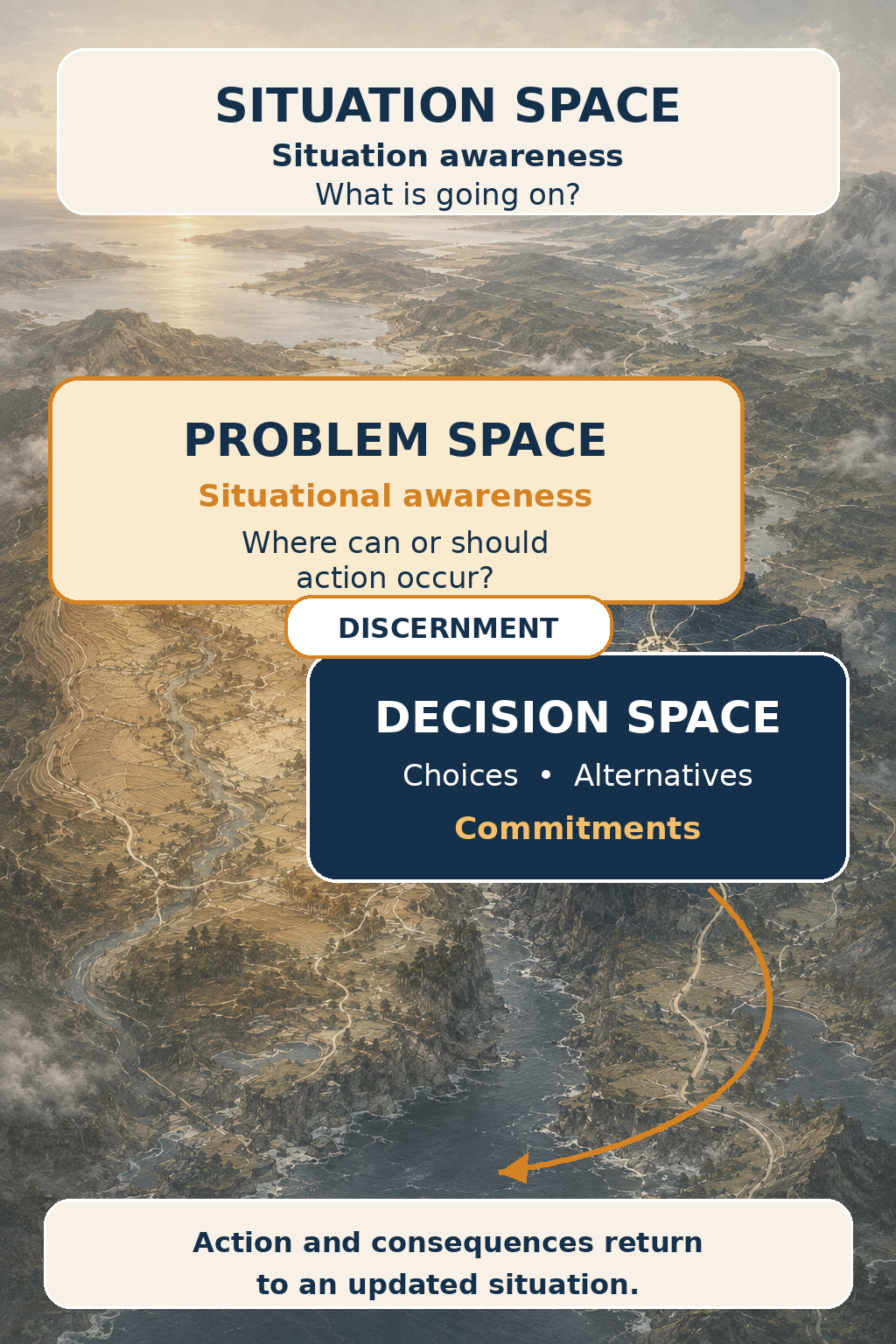
PHRONEXUSworks™ uses three interacting spaces to keep awareness, framing, decisions, action, and consequences connected.

Situation, Problem, and Decision Spaces interacting as action and consequences return to an updated situation.

Situation Space reveals what is going on.

The Situation Space brings conditions, context, relationships, events, signals, stakeholders, constraints, and possibilities into view.

Question: What is going on?

Problem Space locates possible action.

The Problem Space works within the Situation Space to frame concerns, opportunities, boundaries, causes, consequences, and areas requiring attention.

Question: Given what is going on, where can or should action occur?

Decision Space organizes possible commitments.

The Decision Space creates the setting in which choices and alternatives can be developed, examined, and connected with purpose, capability, resources, and potential consequences.

Question: What choices and commitments could move the situation forward?

Movement among the spaces continues throughout the work. New understanding changes the problem frame. A changed frame creates different decision needs. Choices and actions alter the situation encountered next.

Decision needs come before choices.

A clearly formed decision need gives choices and alternatives purpose, boundaries, and context.

Situation / ProblemSpacesDecision-makingsupportDecision needsDecision supportChoice-makingAction andconsequencesUpdated situationfeedback

Directional movement from Situation and Problem Spaces through Decision-making support, which forms Decision needs; then Decision support develops choices; Choice-making commits action; Action and consequences reshape the situation into an Updated situation, which feeds back into the Situation and Problem Spaces.

Decision-making support forms decision needs.

Working through the Problem Space within the Situation Space identifies where judgment, choice, and commitment are required. This creates the areas where decisions are needed.

Decision support organizes choices and alternatives.

Once decision needs are established, evidence, analysis, models, perspectives, and practical knowledge help develop and compare possible responses within the Decision Space.

Choice-making commits action.

People exercise judgment, accept responsibility, and commit capabilities and resources to a chosen course.

Consequences reshape the situation.

Action changes conditions, relationships, capabilities, expectations, and future possibilities. Those changes become part of the situation encountered next.

Together, these relationships move from recognizing where judgment is required, through developing viable alternatives, to committing action and accepting its consequences.

Perspective changes the picture.

Every participant views the situation through a blended perspective shaped by experience, knowledge, role, purpose, and perceived relevance. The blend changes with the person, the conditions, and what captures attention.

Each perspective draws from three connected sources of knowledge.

PractitionerknowledgeAcademicknowledgeStakeholder& UserknowledgeBlendedPerspective

Practitioner knowledge, Academic knowledge, and Stakeholder and User knowledge are three knowledge sources that contribute to every participant’s blended perspective. The sources overlap and integrate while each remains distinguishable.

Practitioner knowledge grounds interpretation.

Experience reveals how work unfolds under real conditions, where formal plans meet constraints, judgment, timing, and consequence.

Academic knowledge disciplines understanding.

Research, theory, and structured inquiry extend the picture, test assumptions, and connect the immediate situation with accumulated knowledge.

Stakeholder and user knowledge reveals lived effects.

People who experience the situation, use what is created, or live with the consequences bring needs, values, effects, and possibilities into view.

Integrating these knowledge sources expands what the group can see and consider. Perspective becomes a resource for developing shared understanding while preserving differences that remain consequential.

Solution-making connects the work.

Problem-solving applies knowledge and skill to portions of the situation that can be defined, analyzed, and worked through. Solution-making connects those efforts across the wider landscape of people, purposes, relationships, capabilities, resources, consequences, and change.

PHRONEXUSworks™ brings that connection to life through Mindset, Methods, and Mechanisms.

Mindseta way to thinkMethodsa way to doMechanismsa way to makecontinuous interactionSolution-makingconnects the work

Mindset (a way to think), Methods (a way to do), and Mechanisms (a way to make) interact continuously and mutually reinforce one another. All three contribute to Solution-making.

Mindset orients how you approach the situation.

A way to think supports curiosity, discernment, judgment, learning, and openness to what the situation may reveal.

Methods discipline how understanding and action develop.

A way to do provides structured approaches for exploring, framing, deciding, coordinating, assessing, and adapting.

Mechanisms carry capability into practice.

A way to make connects people, processes, resources, tools, authority, and timing so understanding can influence what happens.

Mindset shapes the approach. Methods organize the work. Mechanisms make coordinated action possible. Together, they connect practical reasoning with the capability to move through hard problems.

Learning keeps the path open.

Every action produces information. Consequences reveal relationships, test assumptions, and change the conditions surrounding the work. Learning keeps that experience connected to what happens next.

Three integrated cycles sustain that movement.

Learning Cycle — encompassingUnderstandFocusActDoCheckLearnProduction Cycle — withinKnowledgeConceptCapabilityProcessOutcomesAssessmentResource Management — within the workEndsWaysMeansevidence returns to learning

The Learning Cycle encompasses the work: Understand → Focus → Act → Do → Check → Learn. The Production Cycle operates within it: Knowledge → Concept → Capability → Process → Outcomes → Assessment. The Resource Management Cycle operates within and supports the work: Ends → Ways → Means. Evidence, outcomes, and assessment return to continued learning and adaptation.

The Learning Cycle develops understanding.

Understand → Focus → Act → Do → Check → Learn

The Learning Cycle encompasses the work. It keeps inquiry, action, evidence, and adaptation connected as the situation evolves.

The Production Cycle builds capability.

Knowledge → Concept → Capability → Process → Outcomes → Assessment

The Production Cycle develops knowledge into something people and organizations can apply, examine, and improve.

The Resource Management Cycle aligns commitment.

Ends → Ways → Means

The Resource Management Cycle connects purpose with the approach and the people, resources, tools, authority, and time needed to act.

The cycles operate together. Learning informs what can be produced. Production reveals which capabilities and resources are needed. Resource commitments shape what can be attempted. Outcomes return evidence to continued learning and adaptation.

Choose your next view.

You now have the first landmarks: hard problems evolve, situation awareness reveals what is going on, situational awareness locates where action can or should occur, problems frame attention, and decision needs develop before choices and commitments.

Perspective expands the picture. Solution-making connects the work. The cycles carry learning, capability, and resources through changing conditions.

Follow the part of the landscape that best matches your next question.

01

Relationships and Architecture

See how perspectives, spaces, cycles, enablers, functions, assessments, and Ends–Ways–Means connect within the larger operational architecture.

Explore the architecture
02

Foundational Works

Enter through connected books that develop practical reasoning, hard-problem navigation, and human–AI co-evolution.

Explore the books
03

Resources

Find figures, videos, explanations, and practical materials that make the relationships easier to see and apply.

Explore the resources
04

About

Discover the experience, inquiry, and continuing development behind PHRONEXUSworks™.

Discover the work

The landscape now has landmarks.

The path will continue to change as understanding develops. PHRONEXUSworks™ provides a connected architecture for seeing more clearly, acting with purpose, learning from consequences, and developing what the situation requires next.